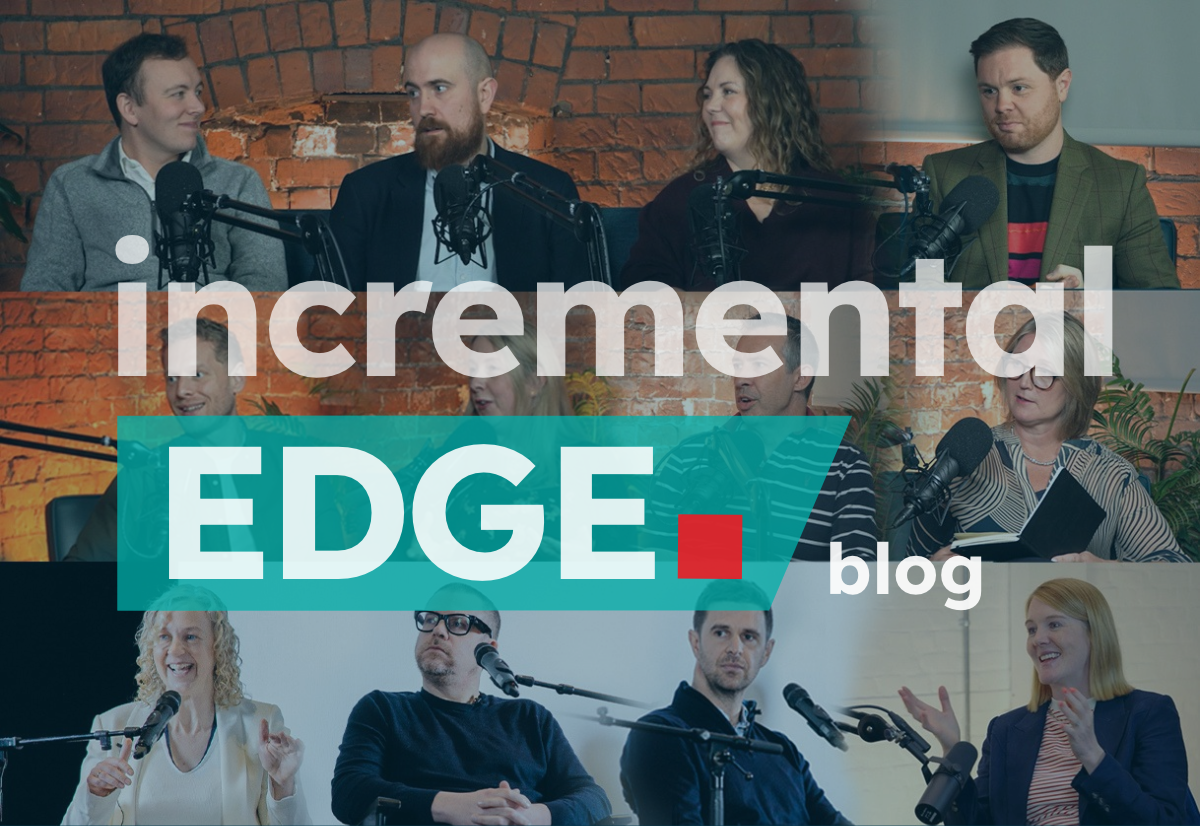
Impactful growth is often assumed to come from one dramatic change, such as a software migration or new product line. More often, it develops through small, intentional changes that build sustainable momentum. Whether it’s a shift in mindset or the automation of a process - small changes add up.
That's why we created the Incremental Edge Podcast.
The Incremental Edge Podcast is a place where business leaders can share personal stories about the small changes that have made a significant difference to their organisations.
Across ten episodes, Emma Pownall and a range of business leaders explored some of the biggest challenges facing growing businesses.
Although every conversation approached growth from a different perspective, the same pattern kept emerging: get clear on what matters, stay close to the work and the people doing it, learn from the result and build from there.
Whether you missed an episode or simply want a quick refresher, here are ten practical lessons explored from Season 1.
Make the business predictable, even when conditions aren’t
Episode 1 - CFOs and Private Equity
Private equity brings pressure to move quickly, but growth rarely follows a plan. Businesses can’t predict the future, but building adaptive financial teams that understand what is changing is essential - private equity or not.
Dynamic reporting and regular communications give investors confidence even when events aren't going to plan.
How can CFOs create greater predictability for investors?
Build your investor roadmap around more than reporting dates. Identify the assumptions behind your plan, the indicators that could signal a change and the points at which action needs to be taken.
Then, when performance moves away from expectations, the conversation shouldn't just focus on the deviation, but highlights what you and the business are actively doing about it and how you can prevent it in the future.
I’ll tell you one thing: no surprises. That’s what PE—they just don’t want surprises… Saying what you’re going to do and doing it.
Matt Hanson, Group CFO at Evolution Funding
Make digital change manageable
Episode 2 - Digital Evolution
For leaders and employees alike, the phrase “digital transformation” suggests disruption, high risk and significant cost. While system resets can be an opportunity, it’s not always the most efficient route to growth.
On the other hand, Digital Evolution is a more manageable alternative: making smaller, people-first changes that are less disruptive. These changes are highly efficient and can build more sustainable momentum over time.
Digital Evolution or Digital Transformation: Which should we do?
Start by assessing whether your existing systems are “good enough” to evolve or whether they are holding the business back.
If they can evolve, start with one improvement, test its impact and scale what works.
If they are pulling you back, then identify what the next steps would be and how to turn this limiter into an enhancer.
Tech is evolving at such a rate that businesses are now having to react quickly to that. And if they’re not adopting those technologies, then their competitors pretty much will be.
Tim Purcell, Chief Technology & Innovation Officer, Datel Group
Bring diverse perspectives into decision-making
Episode 3 - Boardroom Balance
Diversity extends beyond demographic segments. Different perspectives, behaviours and experiences can help teams see challenges from different views and approach problems in novel ways. In a 2023 Korn Ferry survey, 81% of board members recognised the benefits diversity brought.
Without that variety of individuals, boards can become vulnerable to groupthink, which ultimately weakens the group’s ability to adapt and thrive in changing environments.
What to consider when appointing a new board member?
The board is the cultural blueprint for the business. When making your next appointment, think beyond someone’s experience or how easily they will fit. Ask where the existing board is strong and who could complement those already around the table.
What we don’t want is everyone to be the same. We don’t want groupthink… High-performing teams are the ones that bring different behaviours to that board level.
Louise Stephenson, Partner at DRAX
Create capacity for strategic work
Episode 4 - Inside Team GB
Everyday frustrations and process bottlenecks leaves finance teams tied to spreadsheets, with little time to work alongside the wider organisation. Removing that friction and frustration not only provides access to cleaner data and more time to work on it but also a more enjoyable work process.
How do you start implementing incremental changes?
Start with talking to the people who do the work. Their experience helps ensure that improvements reflect how the job is actually done.
Their answers can reveal the repetitive tasks and process bottlenecks are causing the most frustration that you may have never known about.
Rather than trying to fix everything at once, prioritise one improvement with the potential to make a significant difference. Test its impact, learn from the results and build on it.
You need to have the right systems in place to automate all the day-to-day… and then it frees up the time for the team to get into the business.
Sarah Wallace, CFO at Team GB
Measure outcomes, not activity
Episode 5 - The OKR Effect
Clear, focused Objectives and Key Results (OKRs) can turn strategy into meaningful action by showing whether the work is genuinely making a difference.
Outcome-led thinking can transform how teams prioritise. Instead of measuring progress by how many items have been completed, it encourages people to question the value and reason behind an action. This helps teams focus on actions that move the organisation closer to its goals.
How can you use OKRs to measure outcomes?
Before starting a new task, ask yourself: “How will we know this was worth doing?” and “What evidence will tell us it worked?”
These questions help build a mindset focused on impact rather than simply completing a task.
You’ve just got to jump, and you will learn how to fly. It might be a bit turbulent at first, but you will get there.
Roger Longden, founder of There Be Giants
Translate expertise into influence
Episode 6 - The Modern CFO
Technical expertise is expected from CFOs. Yet it's only valuable to the wider business when people can understand and act on it.
Modern CFOs need to translate complex financial information into clear, commercially relevant insight and adapt how they communicate it for different audiences.
How can CFOs translate financial data into business influence?
Before sharing a financial update, make sure you think about the intended audience and what they need and will do with this information.
Remove unnecessary terminology and lead with the impact rather than the technical detail.
Talk to me like I’m three. Once you start doing that - not in a condescending fashion, but by making sure your message is crystal clear - it makes life a lot easier.
Katy Bruce, CFO at UCL Business
Impact matters more than job titles
Episode 7 - How CFOs Get Hired
You wouldn’t hire a recent graduate as CFO - but titles and experience don’t tell the whole story.
Boards and investors look for objective evidence of impact: the decisions they have influenced, the challenges they have navigated and the value they have helped create.
These examples demonstrate whether a candidate’s mindset will be beneficial to the journey ahead.
How can finance leaders demonstrate their impact?
When an issue arises beyond your immediate responsibilities, seize the opportunity to contribute and help.
Offer an informed perspective and work with the people closest to the issue. Record the contribution you made, the outcome and what you learnt. Over time, these examples can demonstrate your impact and readiness for greater responsibility.
We're wanting people who can really influence that change and be a real part of it.
Peter Holt, Partner at Drax Executive
Investment readiness starts early
Episode 8 - Investment Ready?
Investors assess more than financial performance. They also consider how quickly and reliably a business can produce information and whether strong financial disciplines are part of its daily operations.
Reliable reporting, consistent processes and transparent communication must be established long before due diligence begins.
How can a business prepare for private equity due diligence?
Test how quickly and reliably your team can produce key financial and operational information.
If it depends on manual workarounds or last-minute processes, strengthen the process now. During due diligence, you should be promoting that strong foundations already exist - not building them for the first time.
As you go into private equity and introduce debt, leverage and covenants, is your platform robust enough for what’s coming over the next two, three or four years?
Tom Wildig, Senior Investment Director at Palatine
Make customer success everyone’s responsibility
Episode 9 – Why Customer Success Drives Growth
Customer success cannot belong to one department. Every interaction, from marketing and sales to support, shapes the value a customer receives. Consistent improvements across that journey will strengthen relationships, build trust and support more sustainable growth.
How can finance help customer success drive growth?
Start by working with marketing and customer success teams to identify patterns in customer feedback, retention and renewals. You can then develop a focused plan to address the gaps causing customers to disengage or miss out on value.
So, it’s putting the customer at the heart of what you’re doing, understanding what their measures of success are and making sure that they are getting value.
Toby Andrews, Customer Success Delivery Manager at Datel
Lead change beyond finance
Episode 10 - How CFOs Lead Change Beyond Finance
Leading change beyond finance begins with credibility. CFOs need a strong command of their own responsibilities, data and financial position before they can contribute confidently to decisions across the wider business.
That expertise becomes more valuable when it is combined with curiosity and collaboration. By understanding how other departments operate and working with the people closest to each challenge, finance leaders can use their perspective to clarify trade-offs, improve decisions and support change.
How can CFOs lead change across the business?
Identify one priority outside the finance function where financial insight could improve a decision.
Start by listening to the team involved and understanding the operational challenge. Then use relevant data to clarify the options, risks and likely business impact. The aim is to contribute a useful perspective, rather than approach every issue as solely a financial problem.
If you’re there as the CFO, financial controller or whatever your role is, know it inside out. Know your facts and figures.
Katy Bruce, CFO at UCL Ventures
What we learnt from Incremental Edge Season 1
When we bring all ten conversations together, they show that there is no single route to business growth, but meaningful progress often begins in the same way.
It starts with clarity. Whether setting outcomes, preparing for investment or communicating with stakeholders, leaders need to understand what matters and what success should look like.
It then requires staying close to the work and the people doing it. The experiences shared by Team GB, our Customer Success managers and boardroom leaders all showed that the people closest to a challenge often provide the most useful view for what needs to change.
From there, progress comes from implementing a change, measuring its effect and building on what works. Whether that's across digital evolution, finance or investment readiness, the right approach differs between teams and organisations - which is why listening and adapting is just as important as the change itself.
Season 1 showed that meaningful change does not always need to begin with a dramatic transformation. It can start with a clearer question or a single process that makes it easier for people to do their best work.
There may be no one-size-fits-all route to progress, but the pattern was clear: understand what matters, make a deliberate change, learn from the result and build from there.
Thank you to every guest who shared their experience and everyone who watched, listened or joined the conversation.
Incremental Edge will return for Season 2 soon.
Until then, explore Season 1 for more practical insights into private equity, digital evolution, finance leadership, customer success and sustainable growth.